
Vientiane Walking Tours: Getting to Your Starting Point (2026)
Navigate Vientiane like a pro! Discover easy ways to reach your walking tour starting points. Practical tips on tuk-tuks, ride-hailing apps, and more for a smooth Vientiane adventure.
On this page
Vientiane, with its laid-back charm and captivating temples, is a city best explored on foot. A walking tour allows you to soak in the atmosphere, discover hidden gems, and connect deeply with local life. But before you embark on your immersive strolls, understanding how to efficiently reach your tour’s starting point is key. This comprehensive guide will provide all the practical insights you need to navigate Vientiane’s transport options seamlessly, ensuring a smooth start to your unforgettable walking adventure.
Key Tips and Takeaways
- Always agree on a fare *before* getting into a tuk-tuk or unmetered taxi.
- Download and use ride-hailing apps like LocoApp or InDriver for transparent pricing and convenience.
- Carry small denominations of Lao Kip (LAK) for all transport payments.
- Factor in Vientiane’s relaxed pace and potential traffic when planning your travel time to the starting point.
- Utilize offline maps to easily navigate and communicate your destination to drivers.
- Stay hydrated and wear comfortable shoes, even for short walks to your transport or tour starting point.
Understanding Vientiane’s Walking Tour Hubs
Vientiane, with its laid-back charm and relatively compact city center, is a fantastic city to explore on foot. Understanding where free walking tours in Vientiane typically commence, or where you can easily start your own self-guided exploration, is key to maximizing your experience. These ‘hubs’ are chosen for their accessibility, concentration of attractions, and often, the availability of amenities like cafes and transport options.
Here are the primary areas where Vientiane’s walking tours usually begin, or where you’ll find yourself naturally gravitating to start your journey:
-
The Mekong Riverside & Night Market Area: This is arguably Vientiane’s most dynamic and popular starting point, especially for late afternoon and evening explorations. The riverside promenade, stretching from Chao Anouvong Park towards the Presidential Palace, is bustling with activity.
- Why it’s a hub: It offers stunning sunset views over the Mekong River, the vibrant Vientiane Night Market (operational evenings), and a plethora of riverside restaurants and cafes. It’s also easily identifiable and a common drop-off point for taxis and tuk-tuks.
- Attractions nearby: Beyond the market, you’re a short walk from the iconic Chao Anouvong Statue, and a pleasant stroll east or west will lead you to various local eateries and smaller temples. Many guesthouses and hotels are also concentrated in this vicinity, making it highly convenient.
- Practical Tip: If your tour focuses on local life, street food, or the evening ambiance, this will almost certainly be your starting point. Aim to arrive before sunset for the best experience.
-
Central Downtown (around Wat Sisaket & Haw Phra Kaew): For those keen on Vientiane’s rich history and cultural heritage, the area surrounding two of its most significant temples—Wat Sisaket and Haw Phra Kaew—serves as a natural and historically rich walking tour hub.
- Why it’s a hub: These two temples are directly opposite each other, forming a concentrated cluster of historical importance. The Presidential Palace is also just a stone’s throw away, making it an ideal nexus for exploring Vientiane’s past.
- Attractions nearby: Wat Sisaket (known for its thousands of Buddha images), Haw Phra Kaew (the former royal temple, now a museum), and the grand Presidential Palace (viewable from outside). The Patuxay Monument (Victory Gate) is a longer but very walkable distance (15-20 minutes) from here, or a short tuk-tuk ride, often included as an extension of tours starting in this area.
- Practical Tip: Many guided historical tours of Vientiane will instruct you to meet near Wat Sisaket, as it provides an excellent contextual starting point for the city’s religious and royal history. This area is quieter than the riverside but still well-served by amenities.
-
Pha That Luang Area: While less common as an *initial* starting point for a comprehensive city walking tour due to its location slightly outside the main downtown grid, Pha That Luang remains an undeniable walking tour destination and a hub for exploring its immediate surroundings.
- Why it’s a hub: This golden stupa is the national symbol of Laos and a major pilgrimage site. Tours focused specifically on Vientiane’s spiritual side might begin here, but more often, it’s a key stop visited via a short ride from the central hubs, after which extensive walking *around* the stupa and its surrounding temples (like Wat That Luang Neua) can be done.
- Attractions nearby: Pha That Luang itself, several surrounding temples and monasteries, and the large public square where significant national festivals take place.
- Practical Tip: If your interest is solely focused on this magnificent monument and its immediate spiritual complex, you might start here. Otherwise, budget for a quick tuk-tuk or taxi ride from the central downtown or riverside area to reach it, and then enjoy a leisurely walk around the stupa grounds.
Regardless of your chosen starting point, remember that Vientiane is largely flat and very walkable. Always wear comfortable shoes, stay hydrated, and consider the time of day to avoid the midday heat. These hubs provide convenient and engaging launchpads for your Vientiane walking adventure!
Tuk-Tuks: The Quintessential Vientiane Ride
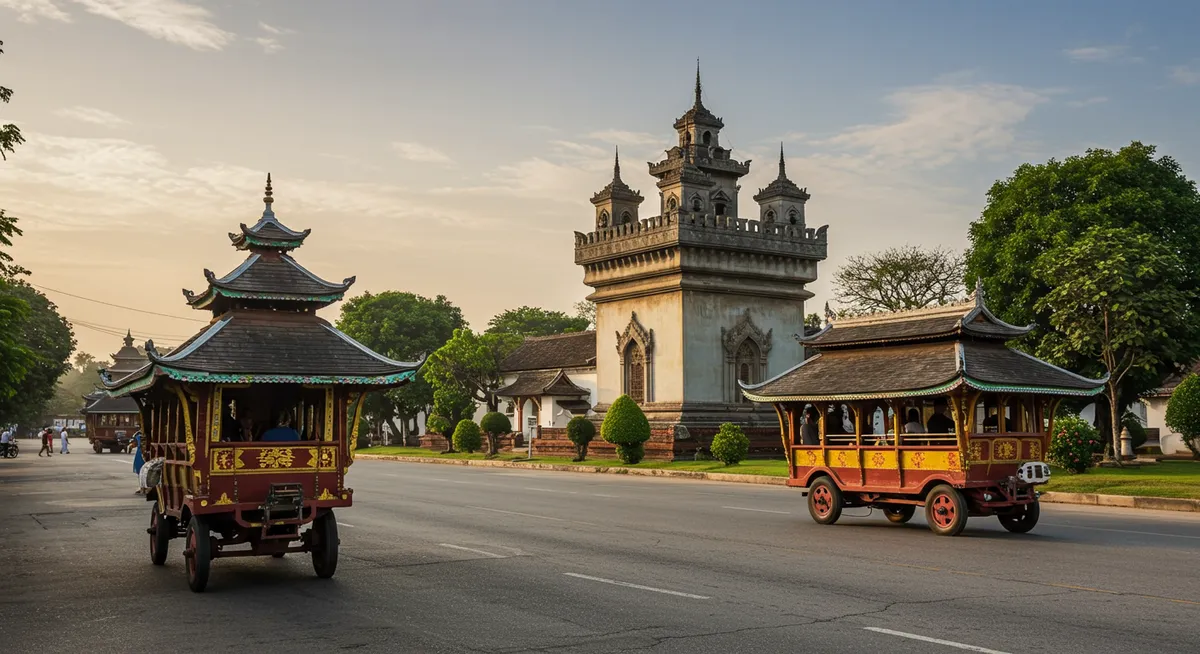
As you embark on your Vientiane walking adventures, you’ll quickly realize that navigating between distinct neighborhoods or reaching your tour’s starting point often calls for a little motorized assistance. Enter the ubiquitous tuk-tuk: an iconic, three-wheeled motorized rickshaw that’s not just a mode of transport, but a quintessential Vientiane experience in itself. While most of Vientiane’s city center is walkable, a tuk-tuk is perfect for bridging longer distances, like getting from the riverside to Patuxay or Pha That Luang, or simply giving your feet a rest after a day of exploration.
Hailing a tuk-tuk is straightforward; they’re plentiful, especially around popular tourist areas, hotels, and markets. You’ll often hear drivers call out “Tuk-tuk? Tuk-tuk?” as you pass. A simple wave of the hand is usually enough to get their attention. However, there’s one golden rule that underpins every tuk-tuk ride in Vientiane: **ALWAYS negotiate the fare BEFORE you get in.** Tuk-tuks in Laos do not use meters, and drivers will invariably quote an inflated price to tourists initially. Your negotiation skills will come in handy here!
For typical short distances within the city center (e.g., from your hotel to the Mekong Riverside Night Market, or between Wat Sisaket and That Dam), expect to pay roughly 20,000-30,000 LAK (approx. $1.00-$1.50 USD). For medium distances, such as from the city center to Patuxay or Pha That Luang, a fair price would be in the range of 40,000-60,000 LAK (approx. $2.00-$3.00 USD). Don’t be afraid to politely counter-offer if their initial price seems too high. A friendly smile and a firm, but fair, offer usually work wonders.
Communicating your destination clearly is key. While many drivers understand basic English, having the exact address or landmark name written down (ideally in Lao script if possible, or shown on a map app on your phone) will prevent misunderstandings. Pointing to your destination on Google Maps or Maps.me is often the most effective method. For popular walking tour starting points like the Presidential Palace or Wat Sisaket, simply saying the name is usually sufficient.
Regarding safety, tuk-tuks are generally safe, but a few precautions are advisable:
- **Solo vs. Shared Rides:** While drivers might offer to pick up other passengers to fill the tuk-tuk (especially if you’re alone), if you’re uncomfortable sharing with strangers, politely insist on having the entire tuk-tuk to yourself. You’ll pay for the full ride, but it offers peace of mind.
- **Valuables:** Keep your bags, phones, and wallets secure and close to your body, especially in crowded areas or at night.
- **Night Travel:** Be a little more cautious when traveling by tuk-tuk at night. Stick to well-lit areas and established drivers if possible.
- **Driver Behavior:** If at any point you feel unsafe or uncomfortable with a driver’s behavior, it’s perfectly acceptable to politely ask them to stop and find another ride.
Incorporating tuk-tuks into your Vientiane walking tour plan is highly recommended. They provide a comfortable and authentic way to cover longer distances, allowing you to save your energy for exploring Vientiane’s fascinating temples, markets, and historical sites on foot. Embrace the ride; it’s an integral part of the Vientiane experience!
Ride-Hailing Apps: Modern Convenience at Your Fingertips
🎯 Insider Tip: Discover the best Vientiane experiences with Viator Tours!
Navigating Vientiane’s charming streets and reaching your walking tour starting points is made incredibly simple thanks to modern ride-hailing apps. Forget the days of extensive haggling or trying to explain your destination in Lao – these apps offer a convenient, transparent, and often cashless way to get around, making them a firm favorite among travelers exploring Vientiane on foot.
While global giants like Grab have a limited presence in Vientiane, the local scene is dominated by user-friendly alternatives that are perfectly adapted to the city’s vibe. Your go-to apps here will primarily be LocoApp and InDriver. These are widely used by locals and tourists alike for their reliability and ease of use, ensuring you can seamlessly transition from your accommodation to the bustling morning market for a food tour, or to the serene Patuxay for a historical exploration.
Why Choose Ride-Hailing Apps for Your Vientiane Walking Tour?
- Effortless Journey to Starting Points: Vientiane’s attractions, while often walkable once you’re in a neighborhood, can be spread out. These apps quickly get you to your tour’s designated meeting spot or the beginning of your self-guided route without fuss.
- Fixed and Transparent Pricing: One of the biggest advantages is knowing your fare upfront. LocoApp generally provides a fixed price, while InDriver allows drivers to bid and you to select a fair price, eliminating any potential for misunderstanding or overcharging. This transparency is a huge relief when you’re focused on enjoying your walking experience.
- Safety and Real-time Tracking: For peace of mind, you can track your ride in real-time, share your journey with others, and see your driver’s details. This is especially helpful when heading out early for a sunrise tour or returning after a late evening stroll.
- Cashless and Convenient: While cash payment is often an option (and always good to have small kip notes), many rides can be paid directly through the app, using a linked credit card or mobile wallet, streamlining your travel logistics.
- Overcoming Language Barriers: Simply input your destination, and the app does the rest. This avoids any miscommunication about where you need to go, crucial for ensuring you arrive at the correct meeting point for your Vientiane walking adventure.
Getting Started with LocoApp & InDriver
To make the most of these apps, follow these simple steps:
- Download Before You Arrive (or with Wi-Fi): Download LocoApp and InDriver from your device’s app store (Google Play or Apple App Store) before you leave home or as soon as you have a stable Wi-Fi connection in Vientiane.
- Register Your Account: You’ll typically need a local or international phone number to register. This usually involves a quick SMS verification.
- Enable Location Services: Ensure your phone’s GPS and location services are turned on so the app can pinpoint your exact pickup spot.
- Book Your Ride: Input your destination (e.g., “Patuxay,” “Wat Sisaket,” or a specific restaurant near your tour start). The app will show available drivers and estimated fares. For InDriver, you might propose a fare or choose from driver bids.
- Confirm and Track: Once a driver accepts, you’ll see their details (name, photo, vehicle type, and license plate). Always confirm these details match before getting into the car. Then, simply track your ride as it approaches.
Practical Tips for Vientiane
- Reliable Internet: A local SIM card (available cheaply at the airport or phone shops) provides the most reliable internet connection for booking rides on the go. Otherwise, ensure you have Wi-Fi access at your accommodation or cafes.
- Pinpoint Your Location: For walking tour starting points that might be less prominent, use nearby landmarks or specific addresses. Dropping a precise pin on the map is always more effective than just typing a general area.
- Small Bills (for Cash): If opting for cash payment, having smaller denominations of Lao Kip is always appreciated by drivers, especially for shorter rides.
- Be Patient During Peak Hours: Like any city, traffic can be heavier during rush hour (e.g., 7-9 AM, 4-6 PM). Allow a little extra time for your ride to arrive if your walking tour starts during these periods.
Utilizing LocoApp or InDriver will significantly enhance your Vientiane experience, ensuring you get to your walking tour adventures smoothly and stress-free, ready to explore the city’s cultural tapestry on foot.
Taxis: A More Comfortable Option
While Vientiane’s compact city center is wonderfully walkable, especially for exploring temples, markets, and riverside promenades, there will be times when a taxi offers a welcome reprieve or a practical necessity. Understanding how to navigate Vientiane’s taxi scene ensures a smooth and comfortable experience, particularly when your feet need a break or you’re venturing further afield for a specific tour starting point.
You’ll find a mix of metered and unmetered taxis in Vientiane, though genuine metered services are less common and often require insistence. Many drivers prefer to quote a flat rate, especially for tourists. This is where a little negotiation and awareness of typical fares comes in handy. Taxis are usually standard sedans, often older models, though you might occasionally see newer, more comfortable vehicles.
When to Opt for a Taxi
Consider taking a taxi in Vientiane for these situations:
- Airport Transfers: For arrivals and departures at Wattay International Airport (VTE), a taxi is the most convenient and comfortable option. Pre-booked airport taxis or those waiting outside the terminal usually have fixed prices.
- Longer Distances: While the core city is walkable, attractions like Pha That Luang, the Lao National Museum (if you’re saving steps), or the far more distant Buddha Park (Xieng Khuan) are best reached by taxi. You’ll save precious walking time and energy for the sites themselves.
- Inclement Weather: Vientiane experiences significant rainfall during the monsoon season (May to October). A taxi provides immediate shelter from sudden downpours, allowing you to stay dry and on schedule. Similarly, during the hot season, a taxi offers a welcome air-conditioned escape.
- Evening & Late Night: If you’re heading out for dinner, enjoying Vientiane’s riverside night market, or exploring nightlife after dark, a taxi provides a safer and more convenient way to get back to your accommodation, especially if you’re unfamiliar with the area.
- Group Travel or Heavy Bags: Sharing a taxi fare among a group can be cost-effective, and it’s invaluable if you’re carrying shopping bags or have specific gear for your tour.
Ensuring a Fair Price
Navigating taxi fares in Vientiane often involves a brief negotiation. Here’s how to do it:
- Ask for the Meter (If Available): Always start by asking if the driver can use the meter. Be prepared for a polite refusal or an excuse. If they agree, great!
- Negotiate Before You Go: If the meter isn’t an option (which is common), clearly state your destination and agree on a price *before* getting into the taxi. Having a rough idea of distances and typical costs will empower your negotiation.
- Utilize Ride-Hailing Apps: The most transparent and often best-value option is to use local ride-hailing apps like Loca or InDriver. These apps provide fixed prices upfront, track your journey, and drivers are usually well-versed in navigating tourist destinations. They’ve become incredibly popular in Vientiane for their convenience and reliability.
- Typical Costs:
- Airport to City Center: Expect to pay around 50,000-80,000 LAK (about $2.50-4 USD), depending on the time of day and your exact destination.
- Short Inner-City Trips: For journeys within the central area (e.g., from your hotel to That Dam or the riverside), expect 20,000-30,000 LAK (about $1-1.50 USD).
- Longer Trips (e.g., to Pha That Luang): Around 40,000-60,000 LAK ($2-3 USD) from the city center.
- To Buddha Park (Xieng Khuan): This is a longer trip outside the city, typically costing 150,000-250,000 LAK ($7.50-12.50 USD) for a one-way trip, or more for a return trip including waiting time.
- Have Small Bills: Laos Kip (LAK) denominations can be large, but drivers often prefer smaller notes for easier change.
By understanding these dynamics, you can seamlessly integrate taxi use into your Vientiane adventure, ensuring comfort and efficiency for reaching your walking tour starting points or winding down after a day of exploration.
Bicycle Rentals: Eco-Friendly & Scenic
For many travelers in Vientiane, particularly those staying within a comfortable cycling distance of our suggested walking tour starting points, renting a bicycle presents an incredibly appealing and eco-friendly transportation solution. It’s not just about getting from A to B; it’s about seamlessly blending your journey with the relaxed pace and scenic beauty of the city, turning transport into an extension of your sightseeing.
Vientiane’s relatively flat terrain makes it ideal for exploring on two wheels. Imagine a leisurely morning ride along the Mekong riverside, feeling the gentle breeze, before you dismount to begin your walking tour of the historic temples or colonial architecture. A bicycle allows you the flexibility to easily reach your tour’s starting point, and then after your walk, perhaps cycle to a charming local café for a coffee or to another nearby attraction.
Finding Your Ride: Rental Locations & Costs
Bicycle rentals are widely available across Vientiane, especially in areas popular with tourists. You’ll find that:
- Guesthouses and Hotels: Most accommodations, from budget guesthouses to mid-range hotels, offer bicycles for daily rental. This is often the most convenient option, as you can rent directly from where you’re staying.
- Dedicated Rental Shops: For a wider selection, potentially better-maintained bikes, or even mountain bikes for more adventurous excursions, look for dedicated rental shops. These are typically concentrated around the Mekong riverside area and the main tourist streets like Setthathirath Road or Samsenthai Road.
As for costs, bicycle rentals in Vientiane are very affordable. Expect to pay anywhere from 10,000 LAK to 30,000 LAK (approximately $0.50 – $1.50 USD) per day for a standard city bike. Some shops might require a small cash deposit or hold onto your passport/ID until the bike is returned, so be prepared for this.
Cycling Safely in Vientiane: Essential Considerations
While cycling in Vientiane can be a delightful experience, it’s crucial to be aware of the local traffic dynamics. The city’s roads, though generally less chaotic than larger Southeast Asian capitals, still require your full attention:
- Ride Defensively: Traffic in Laos drives on the right side of the road. Always keep to the right side of the lane, preferably close to the shoulder, and assume that other vehicles (especially motorbikes and tuk-tuks) might make unpredictable movements.
- Be Visible: While helmets are rarely provided (consider bringing your own if you prioritize safety), ensure your bike has working lights if you plan to cycle early in the morning or after dusk. Bright clothing can also increase your visibility.
- Mind the Road Conditions: Some streets can have potholes, uneven surfaces, or sand/gravel on the shoulders. Stay alert and watch the road ahead.
- Navigating Junctions: Be extra cautious at intersections. Vientiane doesn’t always have clear traffic lights, so eye contact with drivers and clear hand signals can be helpful.
- Parking: Always secure your bicycle with a lock, especially when you dismount for your walking tour. Most temples, shops, and restaurants have designated parking areas.
By keeping these tips in mind, your bicycle rental can truly enhance your Vientiane walking tour experience, offering an efficient, enjoyable, and environmentally conscious way to explore the charming capital of Laos.
Public Buses: Limited but Possible
🎯 Insider Tip: Discover the best Vientiane experiences with Viator Tours!
While Vientiane does possess a public bus system, it’s essential to set your expectations regarding its utility for most tourist-specific walking tour starting points within the city center. Unlike larger, more developed metropolises, Vientiane’s bus network is relatively limited, primarily serving residential areas and outer districts rather than the compact cluster of attractions popular with visitors.
For the majority of Vientiane’s most iconic temples, museums, and riverside promenades – the very heart of what makes an excellent walking tour – you’ll find them conveniently located within a comfortable strolling distance of each other. Attempting to use a public bus for short hops between central sites often proves more time-consuming than simply walking, as routes can be circuitous, and bus stops may not always align perfectly with your desired walking tour kick-off point.
However, the public bus system *can* be a viable, budget-friendly option for specific, longer routes that extend beyond the immediate city center. The most prominent example is a trip to the revered **Pha That Luang** (the Golden Stupa), which is located a few kilometers northeast of the central area. If you’re planning a walking tour segment specifically around That Luang and its surrounding temples like Wat That Luang Tai or Wat That Luang Neua, taking a public bus there and then exploring on foot before returning via bus or tuk-tuk can be a cost-effective strategy.
Navigating Vientiane’s Buses: Practical Tips
- Identifying Routes: Bus stops are typically marked with shelters and signs, though information might be predominantly in Lao. Google Maps can sometimes show bus routes, but verify with your hotel staff or a local for the most up-to-date information regarding specific lines to tourist destinations.
- Fares: Fares are generally fixed and very inexpensive (often around 5,000-10,000 LAK per ride). You’ll pay cash directly to the driver or conductor upon boarding. Small denominations are appreciated.
- Frequency and Reliability: Buses aren’t as frequent as in other major cities. Expect longer waiting times, especially outside of peak hours. Schedules can be flexible, so patience is key.
- Language Barrier: Don’t expect English announcements or extensive English signage. Be prepared to point to your destination on a map or use simple gestures.
For your typical Vientiane walking tour – whether it’s exploring the French Quarter, the Mekong Riverside, or the central temple loop (Wat Sisaket, Haw Phra Kaew, etc.) – relying on your own two feet or a quick tuk-tuk ride is generally more efficient and convenient. But for those looking to experience local transportation or reach a slightly more distant starting point like Pha That Luang on a budget, the public bus system offers a limited but possible alternative.
Walking to Your Starting Point: When It Makes Sense
When planning your adventure in Vientiane, one of the first decisions you’ll face is how to reach your tour’s starting point. While various transport options exist, for many travelers, the most delightful and sensible choice is simply to walk.
Vientiane is renowned for its remarkably flat terrain and a compact city center, especially within the main tourist zones. Unlike the bustling, hilly landscapes of some Southeast Asian capitals, Vientiane’s core is incredibly pedestrian-friendly. This means that if your accommodation is situated anywhere near the Mekong Riverfront, the main boulevards like Setthathirath Road, or within the general vicinity of popular temples like Wat Si Saket and Haw Phra Kaew, chances are your tour starting point is well within easy walking distance.
Walking to your starting point offers a multitude of benefits beyond just getting there. It allows you to immediately immerse yourself in the city’s laid-back atmosphere. You’ll notice the charming French colonial architecture, the quiet hum of local life, and perhaps stumble upon a hidden coffee shop or a vibrant street food stall that you might have otherwise missed from the window of a tuk-tuk. It’s a wonderful way to warm up for your guided exploration, getting your bearings and acclimatizing to the gentle rhythm of Vientiane.
When Walking is Your Best Bet:
- Proximity: If your hotel or guesthouse is within 1 to 2 kilometers (a 15-25 minute stroll) of the designated meeting spot, walking is often the quickest and most enjoyable option. Most tourist-centric accommodations in Vientiane are concentrated in this highly walkable area.
- Morning Freshness: Especially for morning tours, a pre-tour walk in the cooler hours is incredibly pleasant before the tropical heat fully settles in.
- Budget-Friendly: It’s free! Save your kip for delicious Lao coffee or a tasty snack instead.
- Discovery: Consider your walk to the starting point as the very first leg of your Vientiane exploration. Keep your eyes open for interesting details – a local market setting up, monks on their morning alms rounds, or unique shop fronts.
Practical Walking Tips for Vientiane:
- Comfortable Footwear: This is paramount for any walking tour. Ensure your shoes are broken-in and suitable for extended periods on your feet.
- Stay Hydrated: Even on short walks, Vientiane’s humidity can be surprising. Carry a bottle of water, or plan to pick one up at a convenience store along the way.
- Offline Maps: While Vientiane is easy to navigate, having an offline map (like Google Maps or Maps.me) on your phone is always a good idea for peace of mind and to estimate walking times accurately.
- Observe Traffic: Although Vientiane’s traffic is significantly less chaotic than other major Southeast Asian cities, still be mindful of motorbikes and vehicles, especially when crossing streets.
- Allow Extra Time: Give yourself an extra 10-15 minutes than what a map might suggest. This allows for leisurely exploration, photo stops, or simply soaking in the ambiance without rushing.
Embracing the walk to your tour’s starting point in Vientiane isn’t just about practical transport; it’s an integral part of the travel experience, connecting you directly with the city’s unhurried charm from the moment you step out your door.
Essential Tips for Seamless Vientiane Transport
While many of Vientiane’s key attractions are wonderfully accessible on foot, you’ll likely use local transport to reach your walking tour starting points or explore areas slightly further afield. To ensure your journeys are as smooth and enjoyable as your strolls, keep these essential tips in mind:
-
Always Have Small Denominations of Lao Kip (LAK): Cash is king in Vientiane, especially for smaller transactions like short tuk-tuk rides, buying water from a street vendor, or grabbing a snack. Always carry 10,000, 20,000, and 50,000 LAK notes. Larger denominations can be difficult for drivers or small stall owners to break, saving you hassle and ensuring smoother transactions for your onward journey.
-
Utilize Offline Maps (Google Maps or Maps.me): Before you head out, download the Vientiane area on Google Maps or Maps.me. Mobile data can be patchy, and relying solely on Wi-Fi isn’t always practical. Offline maps allow you to pinpoint your hotel, tour meeting points, and points of interest even without internet. This is invaluable for confident, easy self-guided exploration.
-
Learn Basic Lao Greetings: A little effort goes a long way. Learning simple phrases like “Sabaidee” (hello/goodbye) and “Khop jai” (thank you) can significantly enhance your interactions. Locals appreciate the effort; a friendly greeting often leads to a more pleasant experience, from tuk-tuk negotiations to asking for directions. It shows respect for local culture.
-
Communicate Destinations Clearly: Language barriers can sometimes lead to confusion. When taking a tuk-tuk or requesting directions, clearly communicate your destination. The best way is to show the address or landmark name written in Lao (ask your hotel reception to write it down!), or point to it directly on your offline map. This visual aid minimizes misunderstandings, ensuring you arrive at the correct walking tour starting point.
-
Account for Vientiane Traffic: While not as congested as some capitals, traffic can still be heavy during peak hours (around 8 AM-9 AM and 5 PM-7 PM). If you’re relying on a tuk-tuk or taxi to get to your walking tour’s meet-up spot, factor in extra travel time. For shorter distances within the city center, walking might surprisingly be the quicker and more enjoyable option, letting you soak in the street scenes.
-
Prioritize Personal Safety: Vientiane is generally safe, but stay aware of surroundings. Keep valuables secure, especially in crowded areas. When walking, be mindful of motorbikes when crossing streets; they often don’t yield. If walking after dark, stick to well-lit streets or consider a tuk-tuk. Your well-being is paramount to enjoying your Vientiane adventure.
-
Stay Hydrated: Vientiane’s tropical climate means it’s often hot and humid. Prolonged walking tours can lead to dehydration quickly. Always carry a bottle of water with you and sip frequently. You’ll find bottled water readily available at convenience stores and small shops throughout the city. Staying hydrated is crucial for maintaining energy and comfortably enjoying every step of your Vientiane walking experience.
Frequently Asked Questions
Q: Is Vientiane generally walkable for tourists?
A: Yes, Vientiane’s city center and riverside areas are very walkable, featuring flat terrain and many attractions within easy reach. Many walking tours are specifically designed to cover these central zones effectively, allowing you to immerse yourself in the city’s atmosphere.
Q: Are tuk-tuks safe for solo travelers in Vientiane?
A: Generally, yes. Tuk-tuks are a common and safe mode of transport for solo travelers in Vientiane. Always negotiate the fare beforehand, clearly state your destination, and be aware of your belongings. For added peace of mind and transparency, consider using ride-hailing apps which track your journey.
Q: Can I pay for transport in foreign currency (e.g., USD, Thai Baht)?
A: While some drivers might accept USD or Thai Baht, it’s always best and most cost-effective to pay in Lao Kip (LAK) to ensure you get a fair rate and avoid inflated prices or unfavorable exchange rates. Exchange currency at banks or official exchange booths upon arrival.
Q: Which ride-hailing app is best for Vientiane?
A: LocoApp and InDriver are currently the most popular and reliable ride-hailing apps in Vientiane for both tuk-tuks and cars. It’s advisable to download and set up one or both of these apps before your trip for seamless transport booking.
Q: How far in advance should I plan my transport to a tour starting point?
A: For tours starting in the morning, allow at least 15-30 minutes extra travel time, especially if crossing major parts of the city. This accounts for Vientiane’s relaxed pace and any unexpected delays. Traffic can be busier during peak hours (around 7-9 AM and 4-6 PM).
Getting to your Vientiane walking tour starting point is an integral part of your adventure. By understanding the local transportation landscape – from the charming spontaneity of a tuk-tuk ride to the modern convenience of a ride-hailing app – you empower yourself to explore Vientiane confidently and comfortably. Embrace the journey, prepare with these practical tips, and step out onto the streets ready to uncover the unique beauty and tranquility of Laos’s captivating capital on foot. Your Vientiane story begins with every step!